

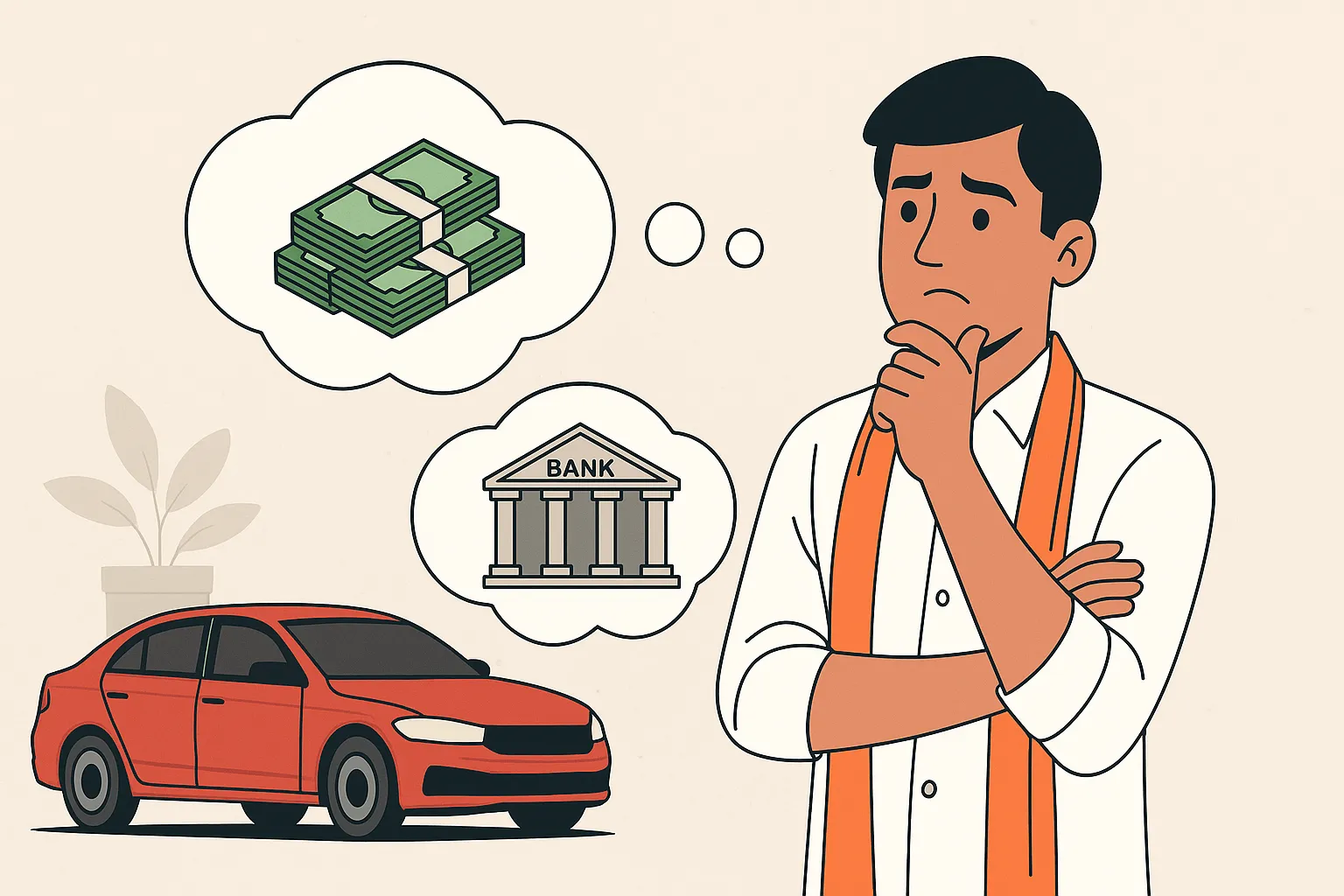
When you dream of a new car, should you swipe your savings in one go or go slow with monthly EMIs? Let’s find out what’s smarter in 2025.
Every family in India, at some point, thinks about buying a car. Maybe it’s your first car, maybe it’s an upgrade. But one big question always comes up: should you buy your car with full cash, or should you take a car loan and pay through EMIs?
In 2025, cars are not just vehicles; they are also dreams, status symbols, and a daily need for many households. But the way you choose to pay for your car can affect your future finances.
This blog will explain, in the simplest way, everything about a car loan or a cash purchase. We’ll cover interest rates in India, car loan eligibility for different types of people, EMI calculators, and even what new graduates should know. By the end, you will clearly know which is the better option for you in 2025.
Understanding Cash Purchase
A cash purchase means you pay the full price of the car in one go. For example, if a car costs ₹6 Lakhs, you give ₹6 Lakhs upfront and drive the car home. No banks, no EMIs, no extra interest.
Advantages of Cash Purchase
- Immediate Ownership – The car is yours from day one. There is no bank involved.
- No Interest Burden – You don’t have to pay extra money as interest. If you buy a car worth ₹6 Lakhs in cash, you only pay ₹6 Lakhs.
- Peace of Mind – No tension of monthly EMI reminders, late fees, or penalties.
Disadvantages of Cash Purchase
- Huge Money Outflow – You need to arrange a large sum of money at once.
- Savings May Get Drained – If you spend all your savings on a car, you might have less money left for emergencies, home, or education.
- Opportunity Cost – If you used that money somewhere else (like investing in mutual funds or FD), it could earn you returns.
Tip: A cash purchase is best when you already have strong savings and your car cost is only a small part of your wealth.
Understanding Car Loan
A car loan means the bank or a finance company pays the car price for you. You repay in smaller parts every month, called EMIs (Equated Monthly Instalments). Along with the money you borrowed, you also pay an extra amount called interest.
Advantages of a Car Loan
- Smaller Payments – You don’t need to pay all the money at once. You can buy a ₹6 Lakh car by paying only ₹1 Lakh as a down payment, and the rest in EMIs.
- Keep Your Savings Safe – Your money stays in your bank account for emergencies or investments.
- Flexibility – You can choose the loan period (3 years, 5 years, 7 years) to make EMIs small and comfortable.
Disadvantages of a Car Loan
- Extra Cost – The car will cost more in total because of interest. For example, a ₹6 Lakh loan at 10% for 5 years can make you pay about ₹7.5 Lakhs overall.
- Paperwork and Approval – You need documents, a credit score check, and bank approval.
- Commitment – You must pay EMIs every month. If you miss payments, your credit score drops, and banks can charge penalties.
Note: Car loans are most useful when you don’t want to block your savings or when you want to buy a car earlier in life.
Interest Rates in India in 2025
Interest rates are the most important part of a car loan.
In India in 2025:
- The average car loan interest rate is around 9.5% per year. (Source: Reserve Bank of India, Annual Report 2024–25)
- For salaried people, banks offer special lower rates, sometimes as low as 8.25%.
- For self-employed people, rates are slightly higher, usually around 9% to 10%, because income is less predictable.
- New graduates often pay 0.25–0.5% extra, unless they have a co-applicant, like parents.
Car Loan for Different Types of People in India
A. Salaried People
If you are a salaried employee in India, you are the bank’s favorite customer. Banks like SBI, HDFC, and ICICI offer:
- Low interest (starting 8%–8.5%).
- Quick approvals with just salary slips, bank statements, and ID proof.
- Extra offers if your company is listed with the bank.
Tip: Always ask your HR if your company has tie-ups with banks. You may get a lower interest rate.
B. Self-employed People
If you are self-employed, banks need more proof of your income, like:
- Last 2–3 years Income Tax Returns.
- Business bank statements.
- Proof of office or shop.
Because income is uncertain, banks charge slightly higher interest (9–10%). But NBFCs sometimes make the process easier.
Remember: Keep your ITRs clean and updated. It makes car loan approval faster.
C. New Graduates
Many new graduates in India want to buy their first car. But banks worry because fresh graduates often don’t have a stable income history. That’s why:
- Interest is slightly higher.
- Banks may ask for a co-applicant (like parents).
- They may limit the loan amount to a smaller car.
Note: If you are a new graduate, show your offer letter, salary slip, or add your parent as a co-borrower.
How to Calculate Your EMI (Step by Step)
An EMI depends on 3 things:
- Loan amount (how much you borrow).
- Interest rate.
- Loan period (years).
Let’s take an example:
- Loan amount = ₹6,00,000
- Interest rate = 9.5%
- Loan period = 5 years
Monthly EMI will be around ₹12,600. Over 5 years, you will pay ₹7,56,000. This means you pay ₹1,56,000 extra as interest.
Tip: Use free online EMI calculators before you apply. Try different combinations. If EMI is above 30–40% of your monthly income, it’s risky.
Comparing Car Loan and Cash Purchase in Detail
Now let’s compare without a table, just in plain words.
When you buy a car with cash, you finish the deal in one go. You feel free, no monthly payment, no extra charges, no stress. But the price is heavy on your savings.
When you buy a car with a loan, the pressure is spread over years. Your monthly EMI may look small, but in the long run, you pay a lot more than the actual price of the car. You also remain committed for years.
So, cash gives you freedom but empties your savings. A loan gives you comfort but costs extra.
You May Also Like to Read this Article -
Practical Tips for Choosing in 2025
- Check Your Savings First: If you can pay cash and still keep 6–12 months of expenses as savings, cash is safe.
- Compare at Least 3 Banks: Don’t accept the first offer. Check SBI, HDFC, ICICI, and NBFCs.
- Plan EMI Carefully: Don’t let EMIs eat up more than 30–40% of your salary.
- Think Long Term: A Car is a depreciating asset, it loses value every year. Don’t stretch the loan period too long.
- Prepayment Option: Ask if the bank allows early loan closure without penalty. This saves a lot of interest.
- Graduates & Self-employed: Always add a co-applicant for easier approval.
Important Things to Remember
- Interest Adds Up: Even 1% difference in rate can save or cost you ₹20,000–30,000 over 5 years.
- Credit Score Matters: A score above 750 gets you the lowest interest.
- Future Loans: If you don’t pay EMIs on time, your future home loan or personal loan gets costly.
- Resale Value: A car bought for cash or loan has the same resale value. The difference is only in how much you spent in total.
You May Also Like to Read this Article - Car Loan Calculator vs Manual Calculation – What’s Better?
Real-Life Examples
Example 1: The Salaried IT Employee
Ramesh works in Bengaluru, earns ₹60,000 per month. He wants a car worth ₹8 Lakhs.
- If he pays cash, his savings will drop from ₹10 Lakhs to ₹2 Lakhs.
- If he takes a loan, EMI is ₹17,000 per month. His savings stay safe.
Ramesh chooses a loan because he wants to keep money for his new house booking.
Example 2: The Self-employed Shop Owner
Meena owns a shop in Surat. She has ₹12 Lakhs saved. She wants a small car worth ₹5 Lakhs.
- She pays full cash because she wants no extra cost and still has enough left for business needs.
Example 3: The New Graduate
Arjun just got his first job in Pune with a ₹25,000 salary. He wants a car worth ₹4 Lakhs.
- The bank gives him a loan with his father as a co-applicant. EMI is ₹9,000 per month.
- He chooses a loan because he cannot pay in full.
“Buying a car outright saves money, but paying slowly with EMIs saves your savings.”
FAQ’S
1. Is it better to buy a car with cash or take a loan in 2025?
In 2025, buying with cash saves you from paying interest, making the car cheaper overall. But a car loan helps keep your savings safe and allows you to manage payments in smaller EMIs. The better choice depends on your savings, income stability, and financial comfort. If you have enough savings left after purchase, cash is smarter.
2. What is the best car loan interest rate in India for salaried employees?
For salaried employees in India in 2025, the best car loan interest rates start around 8% to 8.5% per year from leading banks like SBI, HDFC, and ICICI. Rates vary based on salary, credit score, and employer tie-ups. Always compare multiple banks and use an EMI calculator before finalizing your car loan.
3. What documents are required for self-employed car loan eligibility in India?
Self-employed individuals need to provide income tax returns (ITRs for 2–3 years), bank statements, business proof, address proof, and ID proof. Since income is not fixed like a salaried job, interest rates are slightly higher (around 9–10%). Keeping financial records updated improves approval chances. Some NBFCs may offer easier eligibility with fewer documents compared to banks.
4. How do I calculate the lowest EMI for a car loan in India?
You can calculate your lowest EMI using an online car loan calculator. Enter the loan amount, interest rate, and loan tenure. For example, a ₹6 Lakh loan at 9.5% for 5 years gives an EMI of about ₹12,600. Longer tenure reduces EMI but increases total interest paid. Always balance affordability with overall cost.
5. Which banks give the easiest car loan approvals in India?
Banks like SBI, HDFC Bank, ICICI Bank, and Axis Bank are known for easy and fast car loan approvals, especially for salaried employees. NBFCs such as HDFC Ltd. and Bajaj Finserv also provide quick processing with minimal paperwork. Having a good credit score (750+), stable income, and a relationship with the bank makes approvals faster.
Conclusion
In 2025, whether you choose a car loan or a cash purchase, the best decision depends on your savings, your monthly income, and your comfort level.
- Choose a cash purchase if you have strong savings and don’t want to waste money on interest.
- Choose a car loan if you want to keep savings safe, build a credit score, or buy a car sooner.
Remember, cars lose value every year. So don’t stretch yourself too much for luxury. Choose wisely, and let your car be your joy, not your burden.