

“Do you know a simple car loan mistake can cost you thousands of rupees over the years?”
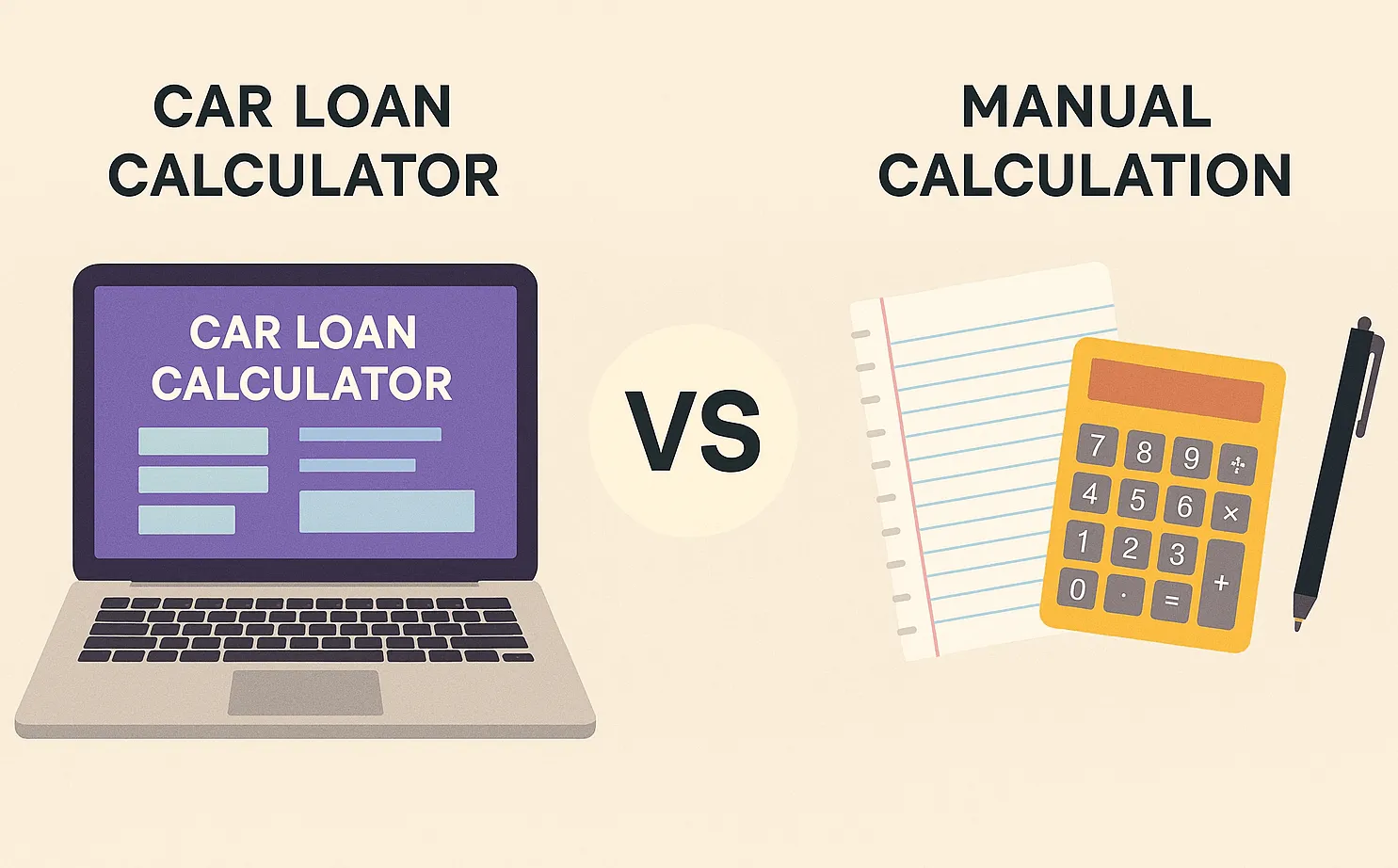
When you dream of buying a car, excitement takes over. But behind the scenes, there’s an important calculation to do: How much will the loan actually cost you every month? Some people sit with a pen, notebook, and calculator to do the math manually. Others open an online car loan calculator and get the answer in one second.
But which one is better? Should you trust your manual math or rely on a car loan calculator? That’s what we’re going to explore in detail today.
By the end of this blog, you’ll know exactly what to use, how to calculate properly, and how to avoid costly mistakes.
Why Loan Calculation is So Important
Taking a car loan is more than just borrowing money. It’s about committing to pay every month for years. To do that, you must clearly know three things:
- The interest rate – the cost of borrowing money.
- The loan tenure – how long you’ll take to pay it back.
- The EMI (Equated Monthly Installment) – the fixed monthly payment.
If you don’t calculate correctly:
- You may end up paying much more interest than you expected.
- Your EMI might become too high for your budget.
- You might even choose the wrong loan tenure.
According to the Reserve Bank of India (2023), nearly 65% of car buyers in India use loans to buy their cars. That’s a majority. If the calculation is wrong, the financial stress can last for years.
So, loan calculation is not just about numbers—it’s about your peace of mind.
What is a Car Loan Calculator?
A Car Loan Calculator is a digital tool, usually available online, that shows you your EMI in seconds. You just enter three details:
- The loan amount you want (say ₹6,00,000).
- The interest rate your bank is offering (say 9%).
- The number of years you want to repay (say 5 years).
With one click, it tells you:
- How much EMI will you pay every month?
- How much total interest will you pay?
- The final total you’ll return to the bank.
It’s fast, easy, and accurate. No formulas, no pen, no paper.
Tip: Banks, loan comparison websites, and even Google offer free car loan calculators. You can test multiple loan options in minutes.
What is Manual Calculation?
Manual Calculation means doing the EMI math yourself.
There is a formula for EMI:
EMI = P x R x (1 + R)N / ( 1 + R)N - 1
Where:
- P = Loan amount (Principal)
- R = Monthly interest rate (Yearly rate ÷ 12 ÷ 100)
- N = Loan tenure in months
Let’s take an example:
- Loan amount = ₹6,00,000
- Interest = 9% annually = 0.0075 monthly
- Tenure = 60 months
Plugging this into the formula, the EMI comes out to around ₹12,487.
It works perfectly if you are strong in math and comfortable with formulas. But for most people, it looks complicated and confusing.
You May Also Like to Read this Article - How is Car Loan EMI Calculated?
Car Loan Calculator vs Manual Calculation – Detailed Comparison
Now, let’s break it down clearly and slowly.
1. Speed of Calculation
If you use a Car Loan Calculator, your answer is ready in less than one second. Just three inputs and you know your EMI.
If you do Manual Calculation, it can take 10–15 minutes. And if you get stuck with the formula or make a mistake, you may spend even longer.
In today’s fast world, speed really matters.
2. Accuracy of Results
A calculator is designed to give accurate results every single time, as long as you enter the correct numbers.
Manual calculation, however, depends on your math skills. Even a small mistake with decimals or exponents can change the EMI completely.
As a financial expert once said:
“Numbers don’t lie, but people often miscalculate them.”
This is especially true with long formulas.
3. Ease of Use
Anyone can use a Car Loan Calculator—even someone who has never studied finance. It doesn’t require you to remember formulas or understand compounding.
Manual calculation, on the other hand, needs focus, patience, and mathematical knowledge. If you are not confident, it becomes frustrating.
Remember: A small error in manual math can become a big error in real life.
4. Flexibility to Compare
A calculator lets you try multiple scenarios quickly. For example, you can check:
- What if I take a loan for 3 years instead of 5?
- What if I borrow ₹8 lakhs instead of ₹6 lakhs?
- What if the interest rate changes from 9% to 10%?
All of this can be tested in seconds.
With manual calculation, you’ll need to redo the formula each time. That’s tiring and time-consuming.
Tip: Always check at least two or three different loan scenarios before making your decision.
5. Knowledge and Understanding
Here’s where manual calculation shines. When you calculate manually, you learn how the EMI is actually structured. You understand how interest works, how tenure affects EMI, and how the formula is built.
With a calculator, you just see the result without knowing the background math.
So, if you’re a finance student or someone who wants to understand the depth of the system, manual calculation helps.
But if you’re an everyday car buyer, the calculator gives you enough clarity to make a good decision.
6. Chances of Error
Car Loan Calculators rarely make mistakes. The only way they can be wrong is if you put in wrong values, like entering 8% instead of 9%.
Manual calculation is highly prone to errors. Missing one decimal point or mixing up the formula can change the answer completely. Over the years, this can mean thousands of rupees lost.
Note: Errors in financial planning are not just small mistakes—they can cost you hard-earned money.
Let’s look at some real-world data:
- 70% of loan applicants in India use online calculators before applying (Source: CAFRAL Report, 2023).
- A study by Financial Express found that manual calculation often has a 5–10% error margin in EMI values when done by normal users.
- The average car loan size in India is ₹7.5 lakhs with a 5-year tenure (RBI 2023). Even a 2% error in EMI can cost you an extra ₹15,000–₹20,000 over the loan period.
This data shows that using a calculator not only saves time but also saves money.
Real-Life Example – Calculator vs Manual
Imagine you take a loan of ₹8,00,000 at 10% interest for 6 years.
Using a Car Loan Calculator:
- EMI = ₹14,832
- Total Interest = ₹2,66,000
- Total Payment = ₹10,66,000
Using Manual Calculation:
If you calculate perfectly, you’ll also reach the same number. But if you make even a small error—say you round off wrongly—the EMI might come out as ₹14,900 instead of ₹14,832.
That’s a difference of ₹68 every month. Over 6 years, that becomes almost ₹4,900 extra.
This is why calculators are safer for most people.
Tips for Using Car Loan Calculators Wisely
- Check on multiple websites – Different sites may round numbers slightly differently.
- Don’t forget extra charges – Calculators don’t show processing fees, insurance, or penalties. Always ask the bank about hidden costs.
- Plan for prepayments – If you want to pay off early, calculators won’t show the exact savings. Use prepayment calculators separately.
- Save your results – Take screenshots of the calculator output so you can compare later.
When Manual Calculation is Still Useful
Even though calculators are better, manual calculation has its place:
- When internet is not available.
- For students learning finance and wanting to practice.
- To double-check the calculator’s result if you don’t fully trust it.
But in day-to-day life, manual methods are not practical.
Expert Opinion
Finance professionals often say:
“Manual calculations give you knowledge. Calculators give you confidence. And when it comes to money, confidence matters more.”
Remember
- Buying a car is a long-term decision.
- A small mistake in EMI calculation can disturb your monthly budget.
- Always check before you sign the loan agreement.
Final Verdict
After going through all the details, the answer is clear.
For everyday users and car buyers, the Car Loan Calculator is the better option. It’s fast, accurate, and easy to use. It allows you to test multiple scenarios and plan your budget properly.
Manual calculation is good for learning and for understanding the concept of EMI, but it’s not practical for real financial decisions.
What You Should Do Next
- Use at least 2–3 different Car Loan Calculators before applying.
- Compare EMIs for different tenures and interest rates.
- Make sure your EMI fits within 30–40% of your monthly income.
- Ask your bank for a written breakdown of EMIs, interest, and extra charges.
- Learn the manual formula once, so you know how it works, but rely on calculators for decisions.
FAQ’S
1. What is the difference between a car loan calculator and manual calculation?
A car loan calculator is an online tool that instantly shows EMI, interest, and total repayment when you enter loan details. Manual calculation requires using a mathematical EMI formula with pen, paper, or a calculator. Calculators are faster and error-free, while manual methods build understanding but are time-consuming and prone to mistakes.
2. Why is a car loan calculator better than manual calculation?
A car loan calculator is better because it’s quick, accurate, and user-friendly. You can test multiple loan amounts, tenures, and interest rates in seconds. Manual calculation is slower and has a higher chance of errors. For everyday users, calculators save time and money by providing reliable EMI estimates without complex math.
3. Can manual calculation of car loans be accurate?
Yes, manual calculation can be accurate if you use the correct EMI formula and carefully calculate each step. However, it requires strong math skills, patience, and attention to decimals. Even a small mistake can change EMI results significantly. That’s why calculators are more reliable for quick and error-free results.
4. Are car loan calculators 100% accurate?
Car loan calculators are highly accurate if you enter the correct details like loan amount, tenure, and interest rate. However, they may not include extra charges such as processing fees, insurance, or penalties. Always use calculators for EMI estimates, but confirm final costs with your bank or lender.
5. What are the disadvantages of manual car loan calculation?
The main disadvantages of manual car loan calculation are:
- It’s time-consuming.
- The EMI formula is complex.
- Errors are common with decimals and exponents.
- Recalculating for different loan options is tiring.
While it helps you understand EMI structure, it’s not practical for real-world financial planning compared to calculators.
Closing Thought
Money saved is money earned. When it comes to car loans, saving time and avoiding errors is just as important as saving money.
So, when someone asks you, “Car Loan Calculator vs Manual Calculation – What’s Better?”, you now have the answer:
Car Loan Calculator is the smart choice for you.